Building an AI workflow for camera trap surveys
Over four years, we’ve tested different species identifiers, built our own in-house review pipeline, and changed the way we collect data. Here’s what worked, what didn’t and we've learnt.


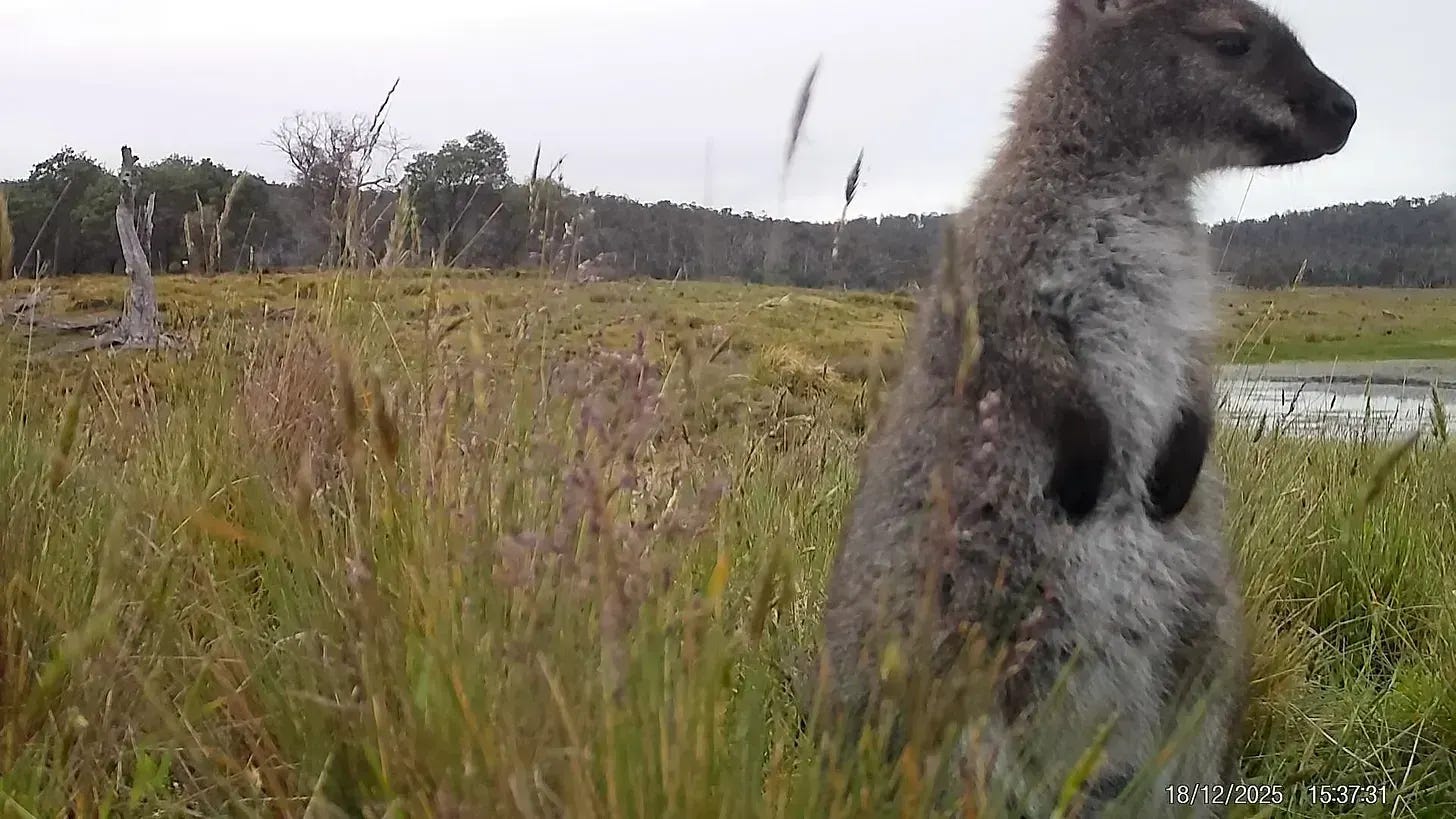
In ecology, more data is almost always a good thing. The more information we have about a landscape or species, the better equipped we are to restore or protect it.
For a long time, collecting ecological data, often in remote and harsh landscapes, was a big challenge. Today, that’s changing. Between camera traps, drones, satellite imagery and acoustic monitoring, we can gather more information about the natural world than ever before.
The challenge now is less about collecting the data, and more about how we process and make sense of it.
We’ve been conducting annual camera trapping surveys at The Quoin, our 7,000-hectare living laboratory in Tasmania’s midlands, since the summer of 2022-2023. Deployed at roughly the same time, in the same locations, for around a month every summer, our network of motion-activated cameras has so far captured over a thousand gigabytes of imagery. That’s modest compared to many monitoring programs, but it’s still far too much for someone to sift through manually.
Over the past four years, we’ve experimented with a range of AI platforms and systems for processing camera trap images. Our approach has evolved significantly in that time, and likely will continue to do so. Like many before us, we’ve found success has less to do with any single standout AI platform or revolution, and more to do with evolving tools suited to our local environment, and designing an efficient workflow around them.
AI has become part of a broader processing pipeline, of which human review and organisation are still essential components without being overly taxing on our time. The AI does the heavy lifting of sorting through the images and suggesting species, but a human reviews the results. We’ve also designed in-house workflows that make the process faster and more accurate.
Animal, person, vehicle or… grass?
Before AI can identify the species in our camera trap images, it first has to answer a much more basic question: is there an animal in the images at all?
At The Quoin, we’re using camera traps to help us build a long-term record of the mammals that call this landscape home so we can adapt our management strategies accordingly. The catch is that up to 75% of the imagery our cameras capture are false positives, spurious triggers activating the cameras’ motion sensors: wind moving grass or trees, direct sun, shifting shadows, nighttime insects, a maintenance vehicle driving by, or a person entering the frame. Culling these images is tedious – the perfect job for machine learning.
After our cameras come in from the field, we first do some basic file management including geotagging every image and giving them all unique filenames (more on that in our camera trap playbook). Then, we run the images though an open-source platform called AddaxAI, which first uses the MegaDetector model to winnow out blank images and classify the rest as animal, human or vehicle.
When it finds what it thinks is an animal, the model makes a tight rectangle around it. This bounding box contains only the animal and no other landscape context. AddaxAI then passes the cropped images to an AI species classifier. We get a list of images sorted into per-species folders with the classifier’s confidence level for each identification.
The challenge of using machine learning models trained on a global database
In our first year of camera trap analysis (2023), we used a popular platform called Wildlife Insights as our AI species recogniser. Developed in a collaboration between Google and some of the world’s leading conservation groups, the platform has been trained to distinguish species based on one of the largest camera trap datasets in the world. The problem was that it wasn’t very good at identifying Tasmanian species back then.
It didn’t know, for example, that there’s only one species each of kangaroo, wallaby and deer in Tasmania, and it didn’t recognise Tasmanian devils or quolls. In the end, around 70% of images needed to be human identified, which was a big strain on our capacity.
This is a common problem with AI-powered species classifiers. They perform better when they’re identifying widespread, abundant and visible species, but face them with a rare, secretive or less widespread species and they’re more likely to make an error.
Of course, as with all AI and machine learning, Wildlife Insights has improved since 2023 as the datasets it’s trained on grow. But back then at least, it wasn’t the right tool for our job.
Finding a Tasmanian-made tool
In 2025, we switched to using the Tasmanian Vertebrates classifier and have found it works well. Developed by Professor Barry Brook and his team at the University of Tasmania, the new open-source AI model was trained on 2.5 million images and can identify all non-flying land-based Tasmanian mammals, over 50 bird species, and general categories such as insects, snakes and unknowns. It’s also freely available through AddaxAI, so was easy to incorporate into our processing pipeline.
The recogniser provides a confidence score for each species ID, with some possible species excluded (we don’t expect any penguins or seals at The Quoin). Setting the right confidence threshold is something of an art. Set it too low, and you get more false-positive IDs (“this brown rock is a wallaby!”): too high, and legitimate animal images don’t get identified as such. Some species are more confidently recognised than others, such as Tasmanian devils and wombats, whereas others, like bandicoots, are less confidently identified. We then pass those species identifications to humans for verification.
Settling on the right system for human review
AI models will always make mistakes – there will be ambiguous images that are too dark or too blurry for them to classify confidently, and species that will fall through the cracks. Humans aren’t infallible either of course; the trick is to create a process that allows each party to do what it excels at. For us, that meant using AI to do the culling, and deciding at which points to bring in human judgement to fine-tune the results.
For the first few years of our surveys, we were reviewing results through Wildlife Insights. Now, we’ve switched to verifying images locally on our own computers through an enhanced human-review pipeline that makes checking the AI’s work much faster.
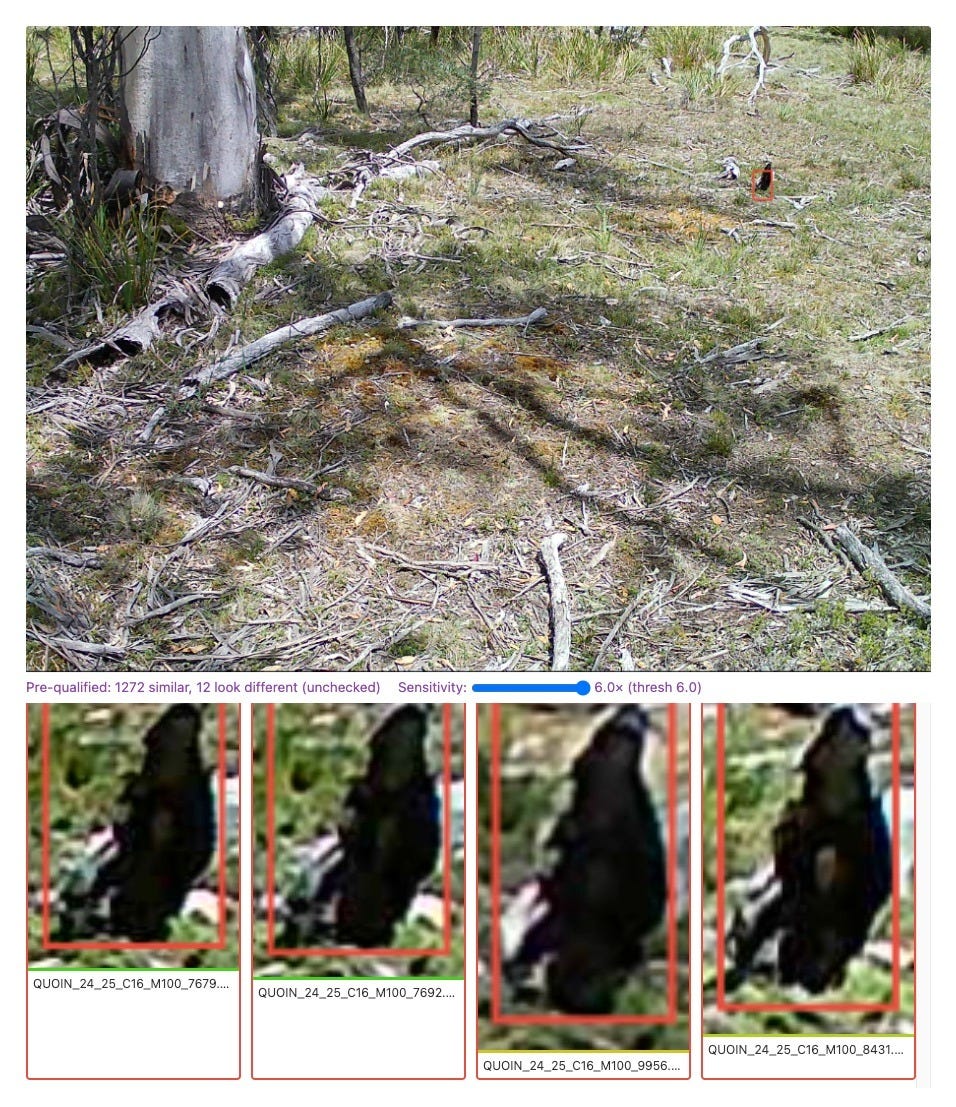
We wrote scripts to collect the image bursts each camera takes (three images captured at one-second intervals, or five- to 10-second videos), and built our own interface to correct species IDs. The pipeline allows us to eliminate bad bounding boxes (a specific poa tussock misidentified as an echidna, or a burnt stick that looks like a forest raven, as in the image above), set minimum sizes for bounding boxes, and multiple other enhancements.
Making the switch to capturing movies instead of still images
One of the biggest shifts we’ve made over the past four years actually has nothing to do with AI at all – it was changing the kind of data we collected. Until last year, our motion-sensor cameras captured bursts of still images. For the summer of 2025-2026, we switched to five- and 10-second movies, making it far easier to identify species.
For machines, recording movies gives them access to more data so they can make better-informed ID suggestions. AI recognisers need movies to be broken down into still frames before they can analyse them. A five-second movie at 15 frames per second could yield 75 frames for the species identifier to chew on. In practice, that’s computationally infeasible, so we give the recogniser images at 15-frame intervals.
When it comes to reviewing the AI’s work, being able to see how an animal moves makes a big difference in our ability to identify it correctly. In a still image, a blurry or dark shape could be either a cat, a spotted-tailed quoll or a brush-tailed possum. A movie makes it easy to tell the difference; the way a cat walks is very different to how a quoll or a possum walks.
The different movements of a quoll (above) and a cat (below) become very obvious when seen as a video.
Humans vs machines: finding the balance
AI recognisers are improving at a rapid pace. A few years ago, it was widely accepted that involving humans ‘in the loop’ was essential for getting accurate results. In May this year, however, a study was published in the Journal of Applied Ecology that compared the results of an expert human workflow to those of an exclusively AI workflow.
Statistically, the results of the two workflows were 85-90% aligned, in other words: remarkably similar. The big exceptions were that the AI workflow missed some rarer species, misclassified others (e.g. mountain goats as domestic goats) and falsely identified others in regions where they haven’t been seen in decades (e.g. grizzly bears in Washington).
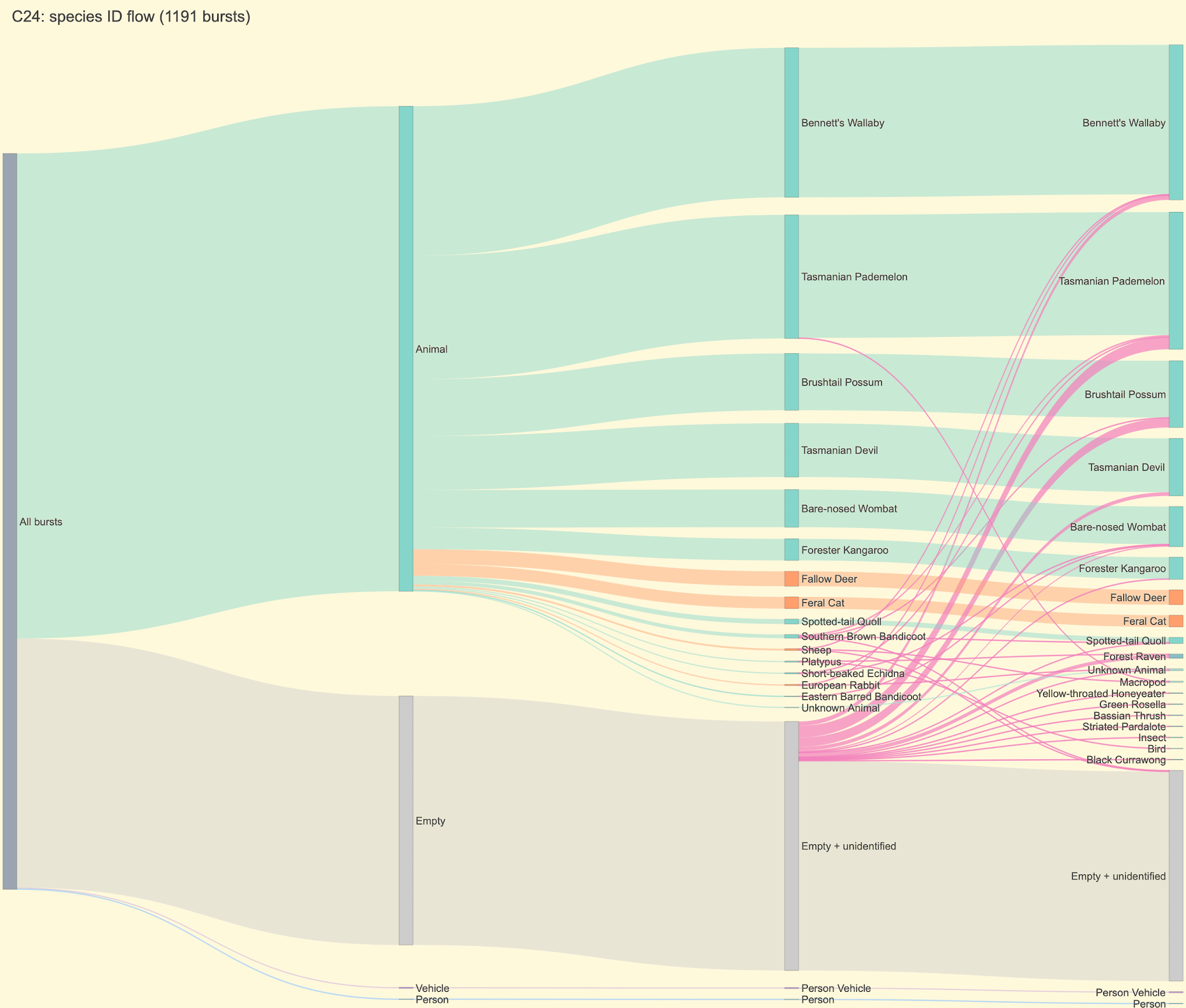
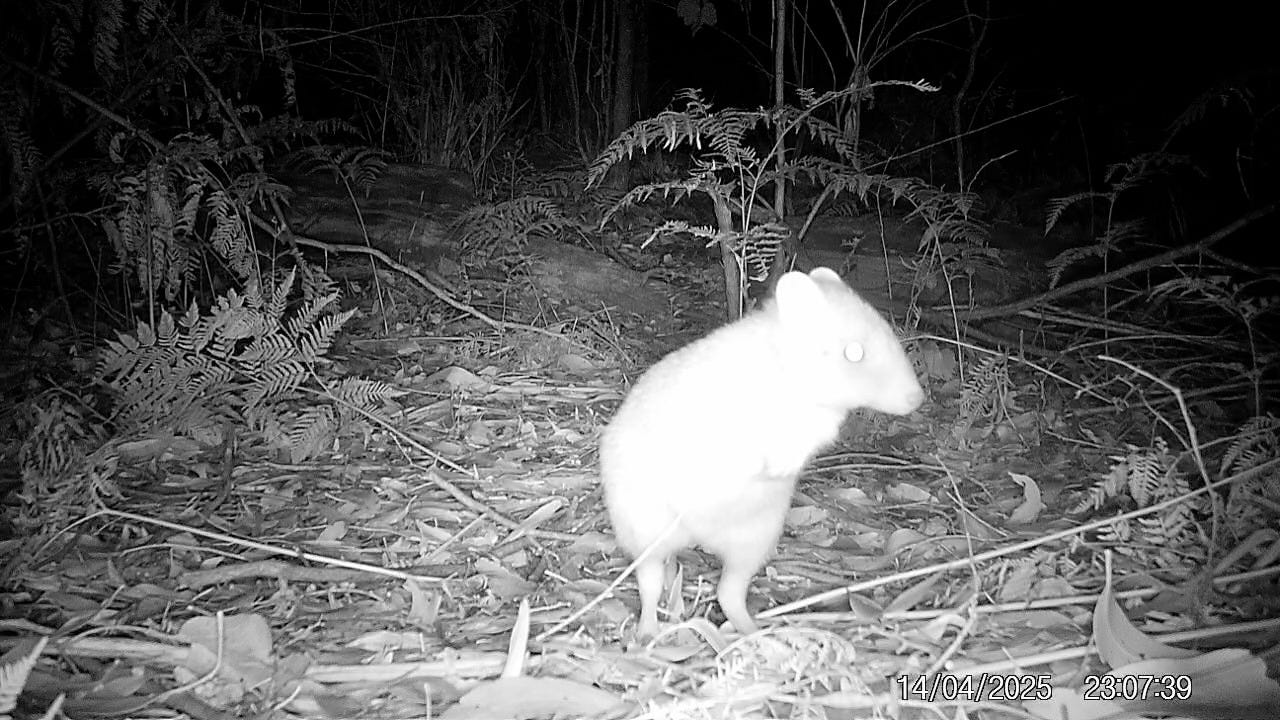
This brings us to one of our big reflections at The Quoin. The effort-reward return on time invested in human reviews depends greatly on which species are being identified. In our latest camera trap surveys at The Quoin, one of our cameras detected 153 sequences of Bennett’s wallaby and 128 sequences of Tasmanian pademelon. By contrast, we are yet to see a single confirmed eastern bettong on the property. These small mammals are now extinct on the Australian mainland due largely to predation by foxes, and are found only in eastern Tasmania.
Is it worth one of our staff spending hours manually reviewing a thousand images just to correct 20 from pademelon to wallaby? Probably not. On the other hand, if one of those pademelons turned out to actually be a bettong…
If your goal is identifying common species, AI may already be accurate enough that extensive human review adds little extra value. But conservation decisions often revolve around the rare and cryptic species that tend to fall through AI’s cracks. As models improve, they’ll become better at identifying those species. For the foreseeable future though, human expertise remains essential for building accurate species lists that can guide how we steward The Quoin and help it flourish.
This article was written by: Michael Honey
And edited by: Amelia Caddy

The Quoin is a living laboratory in the midlands of Tasmania, Australia, where we develop and deploy technologies, products and practices to accelerate regeneration at scale.
If you’d like to collaborate, please get in touch.
And to follow more of our nature-positive work, please subscribe to Wedgetail’s newsletter.